

Conversations are the heart of Family Life. In many families today, everything is well organised – daily routines run smoothly, schedules are coordinated, and messages are exchanged. Yet there is often a lingering feeling: we talk but do not communicate honestly with one another.
Emotional closeness does not arise automatically through living together but through genuine connection.
The psychologist Carl Rogers, one of the pioneers of humanistic psychology, put it this way: “When someone really listens to you, without judging, without defending themselves, it is almost a therapeutic experience.”
This experience is missing in many families. Between smartphone screens, work stress, and the effort to meet all expectations, there is often little room for conversations that go beyond mere organisation.
Digital Proximity – Emotional Distance
Today, the smartphone is often the first and last thing we hold in our hands each day. It facilitates communication – and simultaneously makes it more difficult.
When parents quickly reply to emails at the table, or teenagers stare at their screens during meals, small gaps in interaction quietly emerge. Over time, these gaps accumulate into a sense of distance.
Studies show that digital distraction (“phubbing”) – ignoring someone in favour of a smartphone – significantly reduces relationship satisfaction. Family psychologist Sabine Andresen emphasises: “Children do not learn communication and relationship skills from advice books, but from what they experience daily – in looks, gestures, words, and silence.”
This means that how consciously families engage with one another is more important than how often they talk.
Talking About Emotions – But How?
Many parents want their children to talk about their worries or fears, yet they themselves find it difficult to be open.
Often, this stems from a fear of appearing weak or of burdening the child. However, children learn through honest sharing that emotions are neither “good” nor “bad” – they are human.
Child and adolescent psychiatrist Prof. Michael Schulte-Markwort states: “Those who put their emotions into words have better control over them. Silence creates fear, while talking fosters connection.”
A simple but effective exercise: As a family, ask each other in the evening, “What made me happy today – and what annoyed me?”
This may sound trivial, but it creates continuity in communication and reduces emotional pressure.
Emotional Intelligence and Secure Attachment
Psychologists refer to emotional intelligence as the ability to perceive, understand, and regulate one’s own emotions – while also respecting others’ emotions.
In families where emotions are openly discussed, children typically develop secure attachments and strong self-esteem.
Attachment research (e.g., John Bowlby, Mary Ainsworth) shows that children who experience their parents as reliable listeners, comforters, and responders to their signals develop trust in themselves and in others.
This also applies in later life stages: grandparents who offer time and patience to listen often provide stability – not just for their grandchildren but also for their adult children.
How Families Can Foster an Open Communication Culture
- Create intentional time windows – for example, shared meals without screens.
- Practise active listening – not immediately offering advice but asking questions (“How did that make you feel?”).
- Learn to name emotions – including your own: “I’m feeling irritable today because…” demonstrates authenticity and sets an example.
- Address conflicts instead of avoiding them – disagreements are part of life; what matters is how they are resolved.
- Maintain rituals – such as Sunday walks, shared prayers, or evening gratitude rounds.
These are small but practical steps to make emotional closeness tangible again.
Conclusion: Closeness Can Be Learned
Emotional bonding does not happen by chance but through mindful attention.
When families take the time to listen truly – without immediately judging, comparing, or reacting – trust is built. This is the foundation of mental health across generations.
Family therapist Jesper Juul summarised it perfectly:
“Children do not need perfect parents but authentic people who are willing to engage in relationships.”
For Further Reading
- Carl Rogers: On Becoming a Person (Klett-Cotta, 2004)
- Jesper Juul: Your Competent Child (Beltz, 2018)
- Michael Schulte-Markwort: Burnout Kids (Patmos, 2016)
- Sabine Andresen et al.: Childhood, Family, and Poverty (Beltz Juventa, 2021)
- John Bowlby: Attachment – A Study of the Mother-Child Relationship (Klett-Cotta, 2018)
Reflection Questions
- How consciously do I make time to truly listen and talk with my family about emotions and experiences?
Reflect on whether your conversations go beyond organisational topics and create genuine emotional closeness.
- What role do digital media play in my family life – and how do they affect the quality of our communication?
Consider whether smartphones or other distractions impair interaction within your family.
- What specific rituals or habits could we introduce as a family to foster an open and trusting communication culture?
Think about how shared activities or regular conversation times could strengthen bonds.
Your Opinion?
Author
Dr. Karl-Maria de Molina
CEO & Co-Founder ThinkSimple.io
Project Manager and Chairman of Family Valued
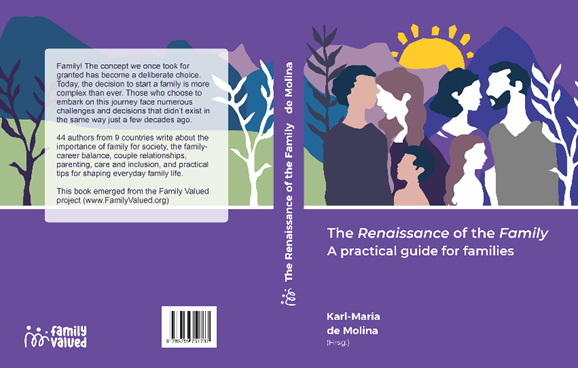
More Information in the book: https://backup.hellas-media.gr/en/renaissance-der-familie-2/
#familyvalued #Therenaissanceofthefamily #FamilyCareerBalance #Kindergarden #Care #Inclusion #Strongfamilies ##worklifebalance #Motherhood #demography #familyandsociety #couplerelationship #parenting #grandparents #CareWork #Parenting #Parenthood #Carework #WorkFamilyEnrichment #Parenting #RaisingChildren #Mindset #Family #ParentingSkills #Relationship