

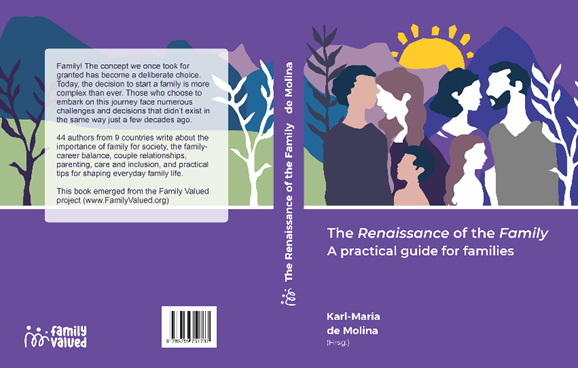
In modern society, where the fast pace of work and the demands of family life constantly seem to compete with one another, the issue of balancing family and career has taken on unprecedented significance. The book The Renaissance of the Family – A Practical Guide for Working Families, edited by Dr Karl-Maria de Molina and published in 2025 as part of the Family Valued project, offers a fresh and practical perspective on this challenge. Based on contributions from international authors, the work not only identifies obstacles but also proposes innovative solutions to create a balance that benefits both family life and professional careers.
Notably, the chapter on “Work-Family Balance” highlights two key articles that redefine the traditional concept: “Work-Life Balance is Dead. Welcome Integration!” by Prof. Nuria Chinchilla Albiol and “To Be HAPPY” by Isabel Gimeno Hernández. Below, these approaches are explored further to understand how tensions can be transformed into opportunities.
The End of Traditional Work-Life Balance: Welcome Integration
Prof. Nuria Chinchilla Albiol, an expert in leadership and work-family balance at the IESE Business School, advocates a revolutionary idea: the traditional notion of work-life balance, as a forced equilibrium between two separate worlds (family and work), is outdated. Instead, she calls for “integration” – a holistic approach in which family and work complement and enrich each other.
“In the family, we learn to yield, to forgive, to wait, and to collaborate.”
According to Chinchilla, traditional work-life balance creates stress by framing work as the enemy of family (or vice versa). Integration, on the other hand, recognises that the skills developed in a family environment – such as time management, empathy, and conflict resolution – are also applicable in the workplace, and vice versa.
For example, a parent managing the daily routines of young children develops multitasking and prioritisation skills that can be directly applied to professional projects.
The book emphasises that this integration cannot occur solely at an individual level but also requires support from companies and policy measures. Chinchilla proposes initiatives such as flexible working hours, remote work, and a corporate culture that values family life. These approaches not only boost productivity but also reduce burnout and enhance employee loyalty.
“The home provides unconditional belonging.”
This approach aligns with the book’s general spirit, which views the family as the foundation of a healthy society. As Dr de Molina mentions in the introduction, families with an active professional lifestyle need practical tools to navigate these challenges – and integration is one such tool. Studies cited in the book, such as those from the National Marriage Project, show that couples who achieve this synergy report higher satisfaction in both their marriages and careers.
To Be HAPPY: A Practical Model for Everyday Life
Complementing this vision, Isabel Gimeno Hernández presents a motivational and practical framework in her article “To Be HAPPY”. The title plays with the term “happy”. It appears to be an acronym representing key pillars for achieving happiness in family and work: possibly H for Harmony, A for Autonomy, P for Purpose, P for Partnership, and Y for Yielding.
“The true identity of each of us lies in our hearts.”
Gimeno emphasises that true happiness arises when holistic well-being is prioritised, without sacrificing either family or work. She suggests practical strategies, such as establishing family routines that include uninterrupted quality time and fostering open dialogue about expectations.
She recommends shared responsibility lists to avoid overburdening individuals and encourages couples to view work as an extension of their family mission, rather than as an obstacle.
“People are not as happy as they wish or could be.”
These approaches resonate with other chapters in the book, such as those addressing roles within the family. Here, the importance of balancing motherhood and fatherhood with professional success is highlighted.
The book illustrates, through real-life examples, how families with multiple children or dual-career parents achieve this integration. In the chapter Families and Their Daily Dynamics, authors like Rosa Pich and Gabriel Mimler share their experiences of how trust and freedom enable them to care for many children while remaining professionally active. These accounts underscore that integration is not a luxury but a necessity to avoid exhaustion and foster personal growth.
Challenges and Opportunities in the Societal Context
Despite progress, the book acknowledges challenges arising from modern societal changes – such as economic pressures, the rise of individualism, and the influence of “woke” ideologies on education. These factors can complicate integration.
Nevertheless, the book’s approach remains optimistic: the family, as a natural institution in the sense of natural law (as discussed by Prof. Carmen Sánchez Maíllo), is resilient and adaptable without losing its essence.
To overcome these obstacles, readers are encouraged to engage in personal reflection, with questions at the end of each article, such as:
- “How can I promote the transmission of values in my daily life while balancing work and family?”
- “What impact do societal changes have on my perception of family?”
These calls to action inspire readers to adjust their attitudes and behaviours.
Conclusion
The Renaissance of the Family not only defends the importance of marriage and family as cornerstones of society but also offers concrete tools for balancing – or rather integrating – family and work. Embracing this paradigm benefits not only individuals and their families but also strengthens society as a whole.
As Aristotle, referenced in the book, argues: “Where there are strong families, there is a flourishing society.”
For anyone struggling with this balance, this book is an indispensable guide to rediscovering the value of integrating personal and professional life and leading a more fulfilled, harmonious existence.
Reflection Questions
- How could I implement the approach of integrating family and work into my daily life so that both areas enrich each other?
Consider which skills or routines from family life might also be helpful at work – and vice versa.
- What specific measures or rituals could my family and I introduce to create greater harmony and balance between work and private life?
Reflect on whether shared routines, open communication, or flexible work arrangements could improve your daily life.
- How do societal or economic conditions influence my perception of family and work – and how can I address these challenges?
Think about which external factors make balancing family and work more difficult and which strategies or resources could help you overcome them.
Your Opinion?
Author
Dr. Karl-Maria de Molina
CEO & Co-Founder ThinkSimple.io
Project Manager and Chairman of Family Valued
More Information in the book: https://backup.hellas-media.gr/en/renaissance-der-familie-2/
#familyvalued #Therenaissanceofthefamily #FamilyCareerBalance #Kindergarden #Care #Inclusion #Strongfamilies ##worklifebalance #Motherhood #demography #familyandsociety #couplerelationship #parenting #grandparents #CareWork #Parenting #Parenthood #Carework #WorkFamilyEnrichment #Parenting #RaisingChildren #Mindset #Family #ParentingSkills #Relationship