

A Comprehensive Contribution Based on Texts from Family Valued
Equality is one of the hottest contested concepts of our time. While political and societal discourses often oscillate between ideologies of gender equality, gender deconstruction, and traditional role models, the authors of the Family Valued book project advocate for a third way: an understanding of equality that respects human nature, avoids pitting genders against one another, and views the family as a place of symbiotic complementarity.
The six theses summarised here form the core of this perspective. They reflect anthropological, philosophical, pedagogical, and sociological viewpoints and are supported by direct quotations from the respective authors.
Thesis 1: Equality Begins with Recognising the Natural Difference Between Genders
1.1 Rationale
The authors criticize a modern understanding of equality that blurs differences and portrays gender distinctions as merely cultural constructs. They argue that true equality is only possible when men and women are taken seriously in their respective natures.
This position builds on a philosophical-anthropological tradition that perceives genders as biologically, psychologically, and relationally distinct but equal in value. Difference is not seen as a hierarchy but as a resource.
1.2 Voices of the Authors
Pilar Castañón Fernández emphasises the anthropological roots of female identity:
- “We must not forget the significant role of women throughout history, shaped by their care for life.”
- “Women have an important task to reclaim their beauty and femininity.”
Edith Stein (quoted) states:
- “What a woman should be, she can only achieve by unfolding her own feminine nature.”
These voices advocate for an understanding of equality that values individuality rather than uniformity.
Thesis 2: True Equality Manifests as Complementary Partnership
2.1 Rationale
The authors view motherhood and fatherhood not as interchangeable roles but as complementary tasks: different yet interrelated. Equality does not mean that both perform the same functions but that both make equally valuable contributions rooted in their identities.
This perspective rejects both patriarchal concepts that devalue women and gender ideological approaches that marginalise fathers.
2.2 Voices of the Authors
Belinda Brown on the importance of male caregiving:
- “The ability to care for and nurture others is a primary expression of masculinity.”
Fathers serve as bridges to the world, acting as a unique resource for socialisation. Ondina María Vélez Fraga highlights the organic development of gender identity:
- “Sexual identity develops harmoniously from biology and the environment.”
In this sense, equality means that men and women serve the same purpose – but in different ways.
Thesis 3: Preserving Female Identity Is an Indispensable Component of Equality
3.1 Rationale
Many female authors in the book warn that modern ideologies either excessively romanticise femininity or completely deconstruct it. As a result, girls and women risk losing themselves in a “neutral gender,” lacking direction and being pushed into roles that do not suit them.
Genuine equality can only succeed if women are not defined from the outside but are empowered in their natural identity.
3.2 Voices of the Authors
Ondina María Vélez Fraga observes increasing confusion in children’s environments:
- “More than ever before, being a boy or a girl is being stereotyped.”
- “Neither my daughter nor that child showed any confusion unless we suggested it to them.”
Pilar Castañón Fernández critiques attempts to “masculinise” women:
- “Nothing is more sexist than trying to turn a woman into a man.”
Women do not achieve equality by being forced into male patterns but by allowing their specific strengths to become culturally impactful.
Thesis 4: Equality Is Most Evident in the Shared Responsibility for the Family
4.1 Rationale
The family is the place where equality must be practically lived – beyond political debates. It is here that men and women cooperate, contribute their strengths, and shape daily life in partnership.
The book project repeatedly emphasises that the most critical resource of a society is not its institutions but its families.
4.2 Voices of the Authors
Carolina and Carlos Aponte, speaking from their experience of a large family, assert:
- “The family is the greatest enterprise, built on faith, love, and openness to life.”
Arantza Albertos de San José highlights the mutual roles of parents:
- “Mothers and fathers play an essential and unique role in their complementary roles.”
Equality within the family is not achieved through uniformity but through shared, responsible cooperation.
Thesis 5: Equality Serves the Common Good Because Both Genders Are Essential for Societal Stability
5.1 Rationale
The authors argue that societies are stable, resilient, and future-oriented when they preserve the natural structure of the family. Equality, therefore, is not only an individual ethical issue but also a socio-political one.
The contributions remind us that history knows of civilisations that destroyed their familial foundations – and failed as a result.
5.2 Voices of the Authors
Goma y Tomás (quoted):
- “The family is a universal structure across all times and cultures.”
Chesterton (quoted):
- “This triangle of self-evident truths of father, mother, and child is the foundation of every culture.”
The message is clear: A society that misunderstands equality and devalues the natural family undermines its own cohesion.
Thesis 6: Equality Is Realised Through Freedom That Becomes Responsibility – Especially in Partnership
6.1 Rationale
True equality requires that freedom is not understood as an end in itself but as the ability to orient oneself towards others in love and responsibility. The authors show that equality in partnership arises when one accepts the other’s weaknesses and prioritises mutual growth over individual self-fulfilment.
6.2 Voices of the Authors
José Víctor Orón Semper describes the essence of married life:
- “Marriage is a school of inner transformation.”
Miriam Cenoz Larrea on growing together as a couple:
- “The union between man and woman is possible when we accept each other’s vulnerability.”
Equality, therefore, is not a right to dominance but a path of mutual self-giving.
Final Reflections
The authors of Family Valued present a sophisticated, nuanced, and genuinely humanistic understanding of equality:
- They see men and women as equal in value but not identical.
- They emphasise complementary partnership as an ideal.
- They protect women’s identity from ideological appropriation.
- They view the family as a place where equality is lived in practice.
- They understand gender differences as a societal resource.
- They advocate for freedom that is proven through responsibility.
In this way, equality becomes a cultural task: not as a battle of the sexes but as a harmony of their strengths – in service of life, the family, and the future of society.
Reflection Questions
- How do I personally understand the concept of equality, and to what extent do I consider the differences and strengths of the genders?
Reflect on whether your understanding of equality is more focused on sameness or mutual complementarity.
- How can I contribute to fostering a complementary collaboration in my family or partnership, where the strengths of both genders are equally valued?
Consider how tasks and responsibilities can be distributed in a fair and collaborative way.
- To what extent do I see the family as a place where equality can be practically lived – and which values would I like to pass on in this context?
Think about the role your family plays in your daily life and how you can model equality for future generations.
Your Opinion?
Author
Dr. Karl-Maria de Molina
CEO & Co-Founder ThinkSimple.io
Project Manager and Chairman of Family Valued
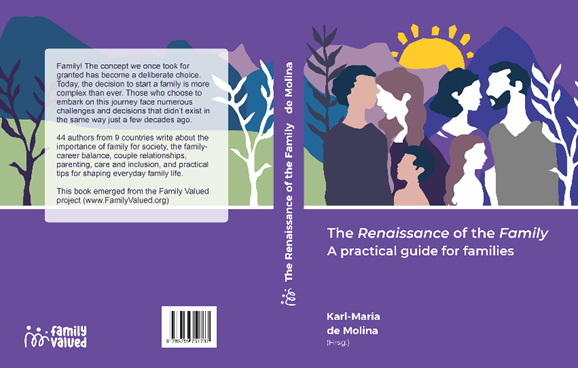
More Information in the book: https://backup.hellas-media.gr/en/renaissance-der-familie-2/
#familyvalued #Therenaissanceofthefamily #FamilyCareerBalance #Kindergarden #Care #Inclusion #Strongfamilies ##worklifebalance #Motherhood #demography #familyandsociety #couplerelationship #parenting #grandparents #CareWork #Parenting #Parenthood #Carework #WorkFamilyEnrichment #Parenting #RaisingChildren #Mindset #Family #ParentingSkills #Relationship